
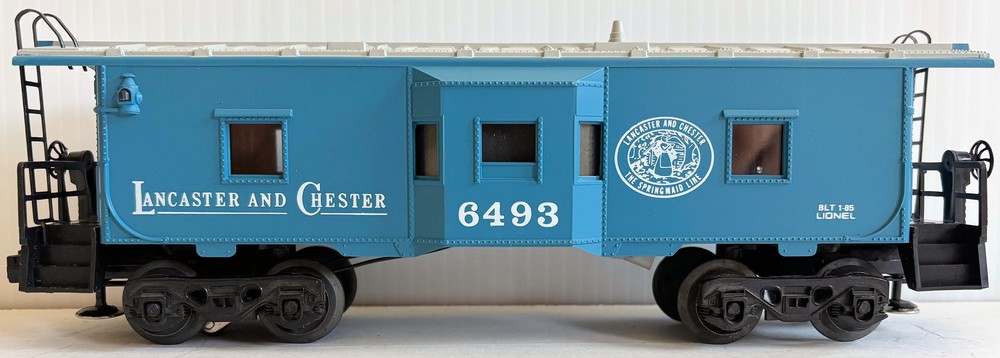
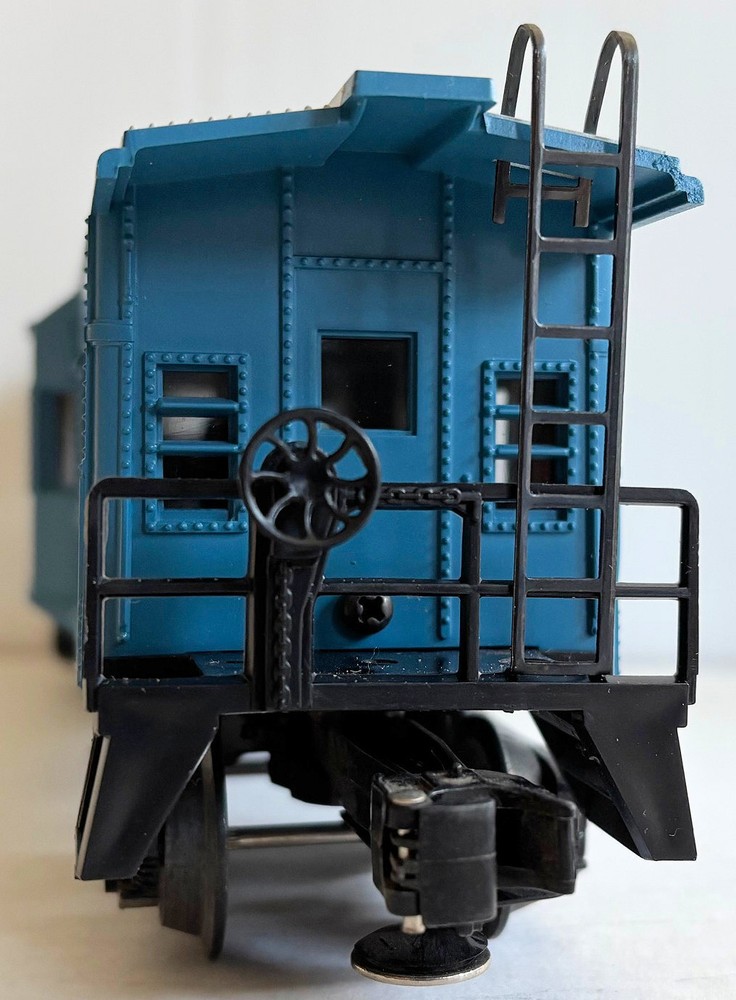
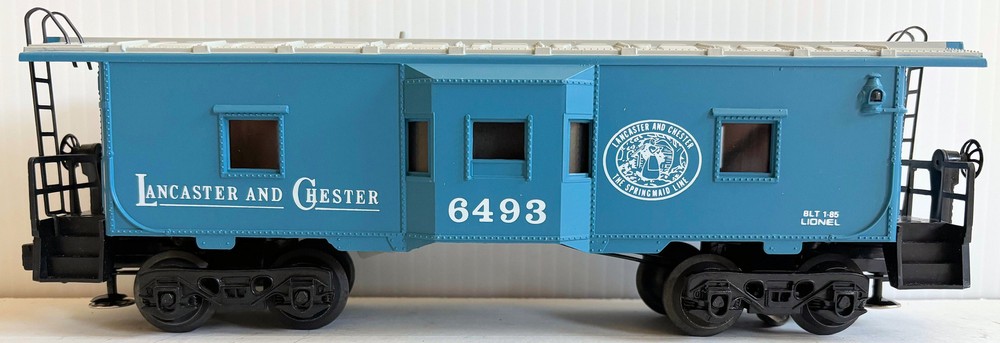
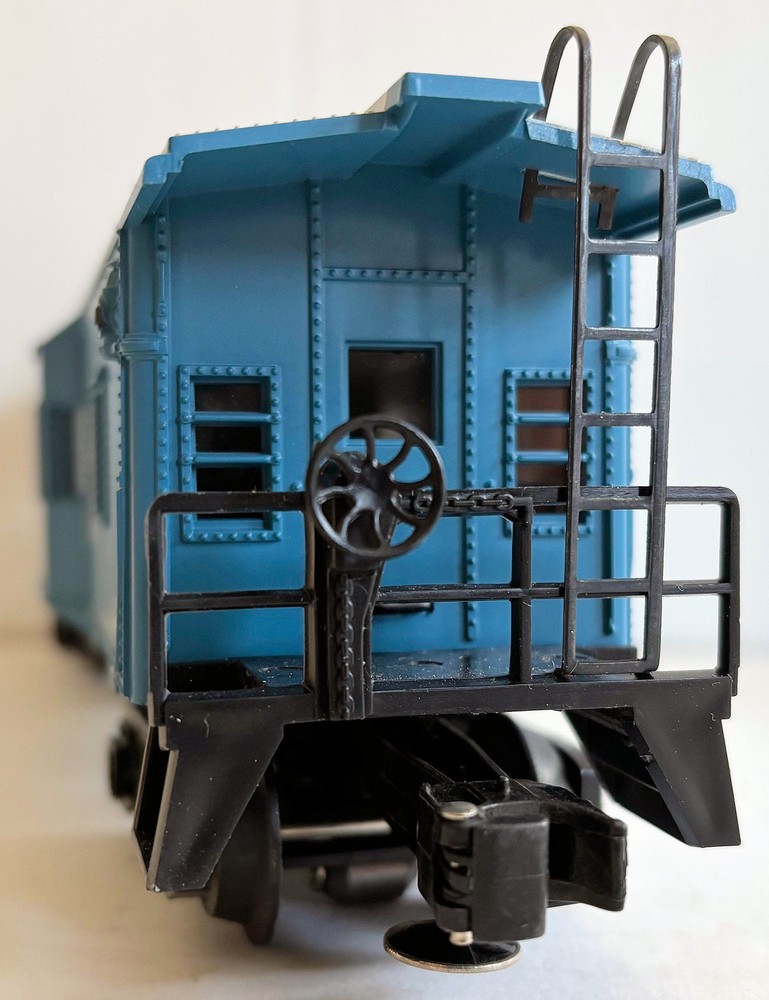
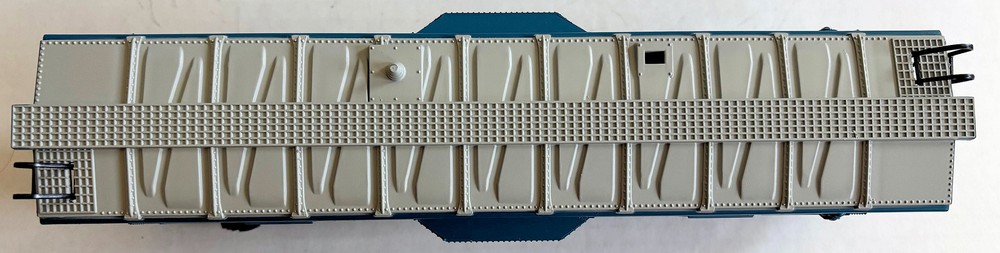
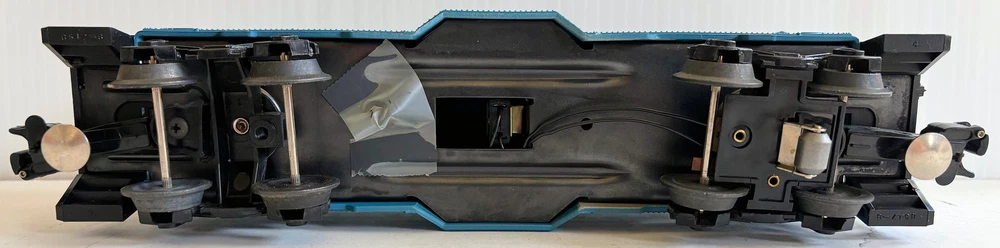
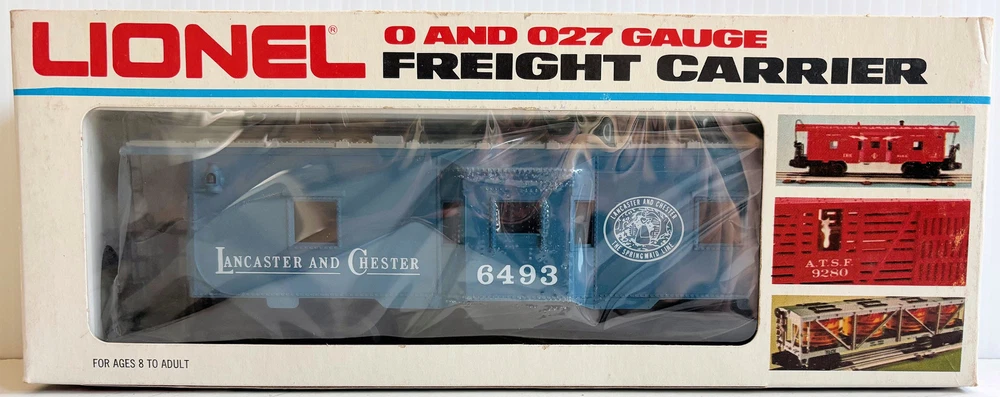
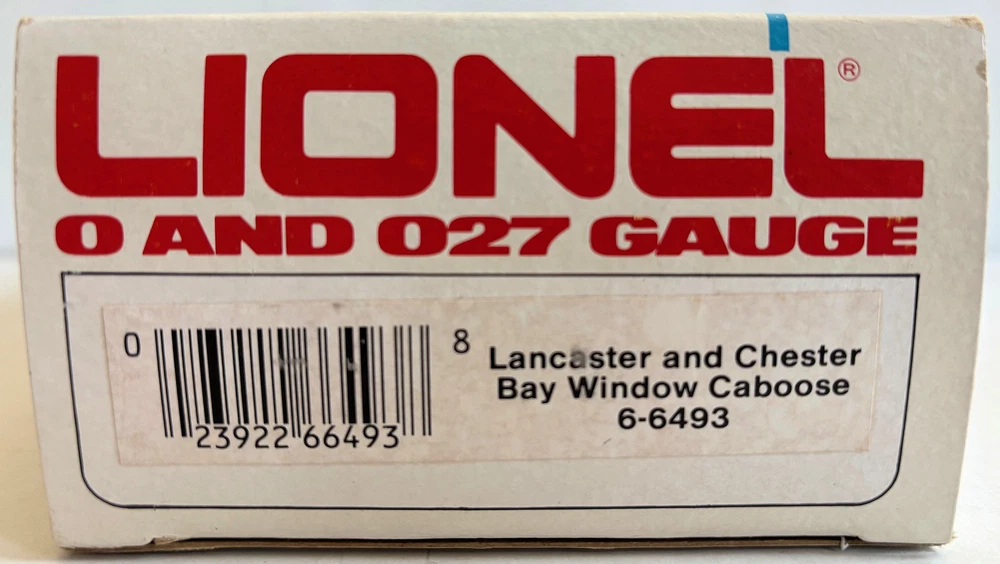
Lionel 6-6493 Lancaster Chester Blue Silver Bay Window Caboose RTR O Scale Train
$ 15.82
Description
LIONEL 6-6493 LANCASTER and CHESTER BLUE SILVER BAY WINDOW CABOSSE LC RTR OVP LIONEL 6-6493 LANCASTER and CHESTER BLUE SILVER BAY WINDOW CABOSSE LC RTR OVP --------------------------------- Additional Information from Internet Encyclopedia The Lancaster and Chester Railroad or L&C (reporting mark LC) is a railway headquartered in Lancaster, South Carolina. The original 29-mile (47 km) route connects Lancaster in Lancaster County with Chester in Chester County. The line's nickname is The Springmaid Line, which refers to its original purpose of connecting the plants of the Springs Mills company. It is owned by Gulf and Ohio Railways.. In 1873, the Cheraw and Chester Railroad Company was granted a charter by a Special Act of the South Carolina General Assembly "to construct a railroad from Cheraw, in Chesterfield County, to Chesterville, in Chester County, by such route as shall be found most suitable and advantageous". In those days, railroads were often built in sections using different contractors and money sometimes ran out before the line was tied together. This happened to the 3 ft (914 mm) narrow gauge Cheraw and Chester. In 1879, it made it the 22 miles (35 km) from Chester County to the Catawba River but did not cross it. On the other end, rail was laid from Cheraw to Pageland before the capital was exhausted in that direction. It operated for three years in these sections before being split. The Chester section was leased to the Charlotte, Columbia and Augusta Railroad, which built a wooden bridge across the Catawba and extended the track one mile (1.6 km) beyond Lancaster in 1883. It was then leased to the Richmond and Danville Railroad, which in turn went into receivership. Meanwhile, the line from Cheraw to Pageland became the Chesterfield and Lancaster Railroad but never extended any further. The receivers for the Richmond and Danville operated the line from Lancaster to Lenoir as one railroad but neglected to pay expenses. It soon returned the Cheraw and Chester to its stockholders. Two years later, in 1896, the railroad was sold by court order at an advertised auction for $25,000 to satisfy its debts. Its buyer, Colonel Leroy Springs, renamed the line the Lancaster and Chester Railroad and organized a company to run it. In addition to Leroy Springs, the incorporators of the new railroad were William Ganson, R. C. McManus, W. T. Gregory, L. C. Payseur, James M. Heath and W. H. Hardin. All of the men were from Lancaster save for Hardin, who was from Chester. The capital stock of the company was $50,000. On June 22, 1896, Hardin, also manager of the Chesterville and Lenoir, was elected manager and auditor of the line. Springs did not have any personal experience in the railroad business. His interest in purchasing the line may have stemmed in part from the fact that his father, Andrew Baxter Springs, had been one of the contractors and directors for the Charlotte, Columbia and Augusta Railroad, which helped form the towns of Rock Hill and Fort Mill, South Carolina. His grandfather, John Springs III, had been an early investor of the South Carolina Canal and Railroad Company, the nation's first operating railroad, and had the privilege of having one of its early engines named after him in the days when engines were named instead of numbered. Springs' brother was president of the Atlantic, Tennessee and Ohio Railroad (AT&O) that proceeded from Charlotte to Taylorsville before it ran out of capital. When he would refer to the AT&O in front of fellow businessmen, Springs would claim to be president of the Lancaster, Klondike and Manila Western Railroad. Although the railroad business as a whole was not prosperous, the newly created L&C did not have to look far for business. Springs had recently completed a textile mill in Lancaster to go with the mills he already owned in Chester, all of which supplied traffic to the railroad. Other businesses in both towns were also served by the L&C. The line connected with the Southern Railway at both ends; with Carolina and Northwestern Railway (itself later part of Southern) at Chester; and with Seaboard Air Line at Fort Lawn. In 1899, both the Catawba River Trestle and Lancaster Depot burned a few months apart from one another. The cost to replace both structures nearly equaled what Springs and his associates paid for the railway three years earlier. However, this misfortune did allow the line an opportunity to upgrade by building a steel trestle to replace the original wooden one. For the first six years of its existence, the Lancaster and Chester Railroad had the distinct disadvantage of being a 3 ft (914 mm) narrow gauge railroad. Thus, it was impossible to exchange cars with the main lines, which were 4 ft 8+1⁄2 in (1,435 mm) standard gauge. Freight had to be unloaded from the main line cars in Lancaster or Chester and reloaded onto the smaller L&C cars and vice versa. Also, the L&C engines had to burn wood because the coal mines were on standard gauge lines and it was not economical to reload the coal on to smaller cars. In 1902, Springs borrowed $125,000 from the Southern Railway to convert the L&C rails to standard gauge. The railway also bought new coal burning locomotives as well as new rail cars. The East Tennessee and Western North Carolina Railroad purchased the old rolling stock from the L&C. By 1913, the L&C owned three steam locomotives, nineteen box cars, two coal cars, two passenger cars, and two combines. Capital stock had risen from $50,000 to $500,000. Then as now, odd-numbered trains ran eastbound and even-numbered trains ran westbound, against traditional railroad operating procedure. This is because before Springs bought the railroad, trains ran through from points north of Chester. Thus, they started their runs as southbound trains which, like westbound trains, normally have odd-digit numbers. They kept their odd numbers all the way to Lancaster on the Chester and Cheraw, even after they turned east at Chester. Later that year, the Lancaster and Chester was persuaded to run a special passenger train to carry fans to a baseball series in Chester County between Chester and Dillon. There were as many passengers on that one train as the L&C ordinarily carried in an entire year. To make the most of the trip, several empty coal cars were attached in front of the passenger cars. When the train reached the Hooper Creek Trestle, one of the hopper cars derailed, taking the three coaches into the creek forty feet (12 m) below. Every person aboard was badly shaken or injured, and five lives were lost. The seventy-one personal injury claims totaled more than $130,000, nearly causing the L&C to go bankrupt. Two weeks after the Hooper Creek derailment, a fire destroyed the Lancaster Depot, which also served as a warehouse for the mill, costing the railway an additional $75,000. It took Springs two years to emerge from the courthouse with his railroad intact. He then was able to borrow enough money to get the line operating again. In 1916, a hurricane-generated flood washed away the three-span Catawba River Trestle as well as the Cane Creek Trestle near the Lancaster Plant. For weeks, the L&C detoured over the Southern line to Catawba Junction and the Seaboard line to Fort Lawn to connect with its own line. A ferry was then built to take the place of the trestle, but this proved to be both slow and expensive. A new trestle would have cost $90,000, more than the railroad was worth before the old trestle was lost. The Southern Railway was not interested in taking the railroad back and building a new trestle. For a year, the option of abandoning operations and taking up the rails to sell for scrap was considered. Springs then heard of a main-line trestle that was about to be abandoned by the railroad that owned it so they could replace it with a trestle that had double tracks. The trestle also included a bridge for automobiles. Colonel Springs bought this trestle and then sold it to the county for what he had paid for it. He was left with only the expense of moving the trestle to the Catawba and attaching it to the stone piers of the old trestle that were spared by the flood. The new trestle fit the piers of the old one. The Lancaster and Chester resumed operations just in time to be taken over by the government during World War I. Elliott Springs Springs died in April 1931 leaving his empire to his only child, Elliott White Springs. Elliott Springs was born just weeks after his father purchased the L&C and had a genuine love for the railway. Under his leadership, the L&C began to prosper in the latter part of that decade, on the eve of the Second World War. In 1939, he brought the L&C national attention when he purchased the Loretto, a rail car that had originally been built for the former president of U.S. Steel, Charles M. Schwab. Springs carefully preserved the splendor of the forty-year-old car's Victorian design—Cuban mahogany paneling, crystal chandelier, velvet draperies, marble bath, and gold-plated beds. He had the Loretto remodeled for office use, then parked it on a siding near the White homestead in Fort Mill. As of 2001, the Loretto is on display at the North Carolina Transportation Museum in Spencer, North Carolina. Springs had a flair for colorful advertising. One of the things he remains best remembered for is the menu he wrote and printed for the L&C dining car. This menu included: Long Island Ugly Duckling stuffed with Turnip Greens and Pearl Onions, Cannibal Sandwich with real collar buttons, Pork Barrel stuffed with Republican, Drawn and Quartered Democrat Roasted in Own Jacket, and Elliott Springs with Garlic and Chlorophyll. Also offered were an alligator pear for one dollar and a pair of alligators for two dollars. Dessert was watermelon Jane Russell, pitted grapes and potted dates. That the L&C did not actually own a dining car at the time did not matter. Springs rarely did anything in a small way and usually had fun doing it. It was his idea to appoint 29 vice-presidents to the railway, one for each mile of track. They included playwright Charles MacArthur, golfer Bobby Jones, artist James Montgomery Flagg, writer Lucius Beebe, radio man Lowell Thomas and his wartime friends Billy Bishop and Clayton Knight. Another one of these fictional vice-presidents was Ham Fisher, who seldom drew a freight train in his Joe Palooka strip without labeling it Lancaster and Chester. However, it was striptease artist Gypsy Rose Lee, named vice-president in charge of unveiling, who got the most attention. Lee was brought to the attention of Springs by his friend, Agnew Bahnson of Winston-Salem, North Carolina. She was a devoted fan of the rails and kept models of famous trains in her basement. In addition to providing menus for dining cars that did not exist and the naming of the colorful vice-presidents, Springs listed a timetable for trains that likewise did not exist. They included The Shrinking Violet, The Black Label, The Purple Cow, The Red Rose, The White Horse and The Blue Blazes. When the New York, New Haven and Hartford denied Springs his request for a pass by writing that they were granted only to those lines that generated traffic for its route, he wrote back, "I note that the New Haven does not consider the L&C Railway of sufficient importance to honor its officials with an annual pass. I have personally routed some two hundred carloads over the New Haven in the past three or four months but you may rest assured that I will do otherwise in the future." When Springs moved into his office at the new company headquarters in Fort Mill, he found himself with a four-foot-high (1.2 m) and 120-foot-long (37 m) blank space on his walls. He proposed a mural of his railroad, the Lancaster and Chester, but several aerial photographers insisted this would be impossible. In spite of this, Springs sent well-known photographer Elliott Lyman Fisher up with company pilot Cecil Neal. They flew up and down the line until Fisher had photographed every foot of track—villages, mills, woodlands and fields. When several mountings of the prints failed to satisfy Springs, Fisher colored each slide by hand. One hundred and eighty lights illuminated the slides from the rear giving them a three-dimensional effect. The mounting of the mural allowed Springs to inspect his railroad any time he wished. In 1946, the L&C upgraded its fleet by buying six diesel locomotives from the U.S. Army. These 65-ton Whitcomb locomotives had seen service in Italy during the war and burned about the same amount of oil to run that the old steam engines used for lubrication. The purchase of these engines made the L&C the first fully diesel-operated railroad in the state, something that Springs liked to boast of. The steam engines formerly used by the railroad were either sold or put out to pasture. However, these diesels did not spend long on the line as they were replaced by three 70-ton 600 horsepower (450 kW) GEs in late 1950. Among the Whitcombs, number 51 passed to the Allegheny and South Side Railway where it would stay until the end of that property. In 1951, Gypsy Rose Lee was on hand in Lancaster to 'unveil' the new Williamsburg-style depot. Her six-year-old son, Erik, was also present and was photographed with his mother in the cab of one of the L&C's locomotives. In addition, Springs gave the L&C its slogan, "The Springmaid Line". He also outfitted a Rolls-Royce as a high rail inspection vehicle. In the late 1950s, the Railway adopted a light blue, gray and white paint scheme to replace the dark blue and white scheme of earlier diesels. H.W. Close Elliott Springs died in 1959 and his son in-law, H.W. Close, became president of Springs and the L&C. In 1961, a steel shop and engine house was built in Lancaster to replace the wood structure that was currently in use. In late 1965, the GE diesels were replaced by two new EMD SW900s. They were given the numbers 90 and 91 and are still in use by the Railway on a regular basis in late 2001. These locomotives handled the traffic on the line—much of the time making two freight runs a day—until December, 1984, when an additional EMD SW900 was added to the fleet and given the number 92. In 1996, two EMD SW1500's, numbered 95 and 96, were added, followed by four EMD SW1200s in 1998, which were numbered 93, 94, 97 and 98. In 2001, the line leased two more ex-Conrails units from Locomotive Leasing Partners, or LLPX, SW1500 #215 and SW1001 #91. Recent events The L&C added another aspect to its operation in 1996 when Bob Willetts began a passenger car restoration program in Lancaster. The J.P. Henderson car was the first to come out of Lancaster. It is currently in charter service on Amtrak. In the late 1970s, this car had been in storage in New York and a state of disrepair. It was bought, then moved to Hartsville, South Carolina where a total renovation began. It went back into service in 1989 and was later bought by the Lancaster and Chester. In 2006, the South Carolina shortline got some national railroad attention again in Pennsylvania. The New Hope and Ivyland Railroad restored their Baldwin steam engine 2-8-0 #40 to her original appearance as a 1920s-era freight locomotive when she worked for the Lancaster and Chester. When the L&C went diesel in 1947, the steamer went to the Cliffside Railroad in North Carolina. Due to the conversion from steam to diesel motive power on the Cliffside, the #40 was sold in 1962. Steam Trains Inc., a Pennsylvanian group of investors, bought the 2-8-0 and had it shipped to the Reading roundhouse in Wilmington, Delaware. By 1966, the equipment was again transferred to New Hope, Pennsylvania where the locomotive operates to this day. However, it is now again lettered for the NH&I. On March 25, 2001, the L&C entered into a lease-purchase agreement with Norfolk Southern to operate the SB trackage in Lancaster County. It is the first expansion in route mileage since the inception of the L&C more than one hundred years ago. On September 2, 2010, Gulf and Ohio Railways announced it was purchasing the Lancaster and Chester; the deal was planned to be completed by November 2010. FREE scheduling, supersized images and templates. Get Vendio Sales Manager. Make your listings stand out with FREE Vendio custom templates! FREE scheduling, supersized images and templates. Get Vendio Sales Manager.
Item listed as “tested”, but no more information. Item arrived with spare parts that were broken at some point. Item arrived appears to have dropped. Motor mounts were broken and small bits within packing. Outside body of engine is fine. Shipping cost seems somewhat high, but I am not familiar with USPS rates. Otherwise all is well, engine can be repaired.
fast delivery time, very protectively packaged for delivery, very good price, accurately described-in factory protective wrap, another example of excellent service and care taken to protect the book, thanks! I have bought several books from this seller, and there has never been any disappointment!
Super smooth transaction all the way around. Shipping was lightning fast. Packaging was superior and magzine was as described. Well worth the value for the price paid. Highly recommend this seller as a must use and one of the best on eBay. I will purchase from again.
Related products
O Scale Lionel 6-19655 Orange Amtrak Tool Car with Lighted Interior Woodside RTR
$ 15.82Lionel Prewar 717K Caboose Shell Only Vintage Train Part
$ 63.36Lionel Prewar 218 Dump Car in Original Condition
$ 63.361953 Lionel Tender Car 2046W with Whistle in Original Box - Estate Fresh Condition
$ 39.58