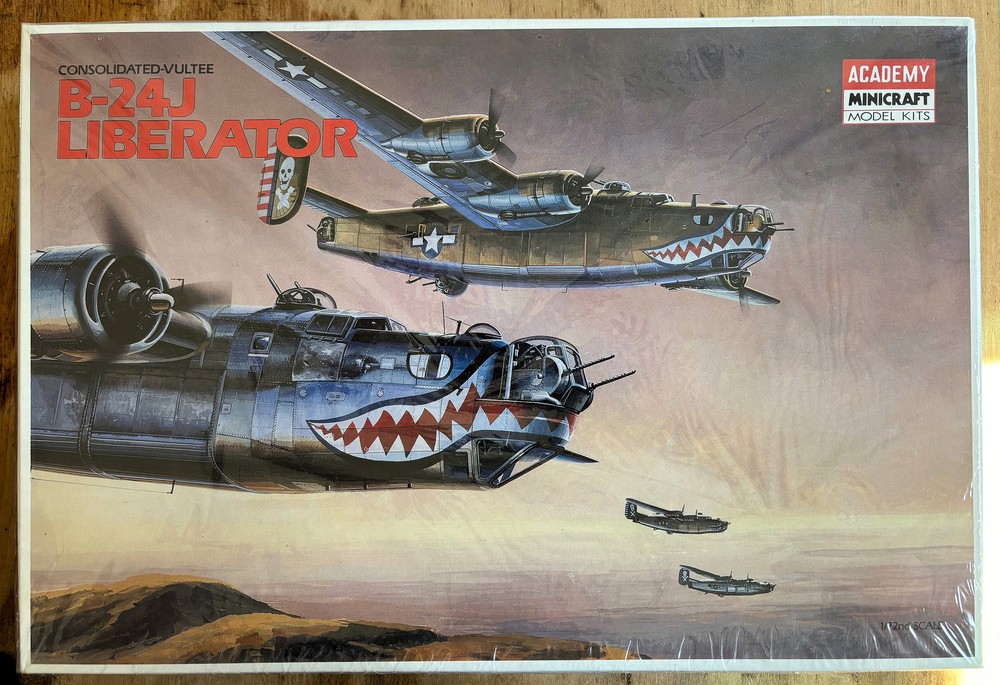
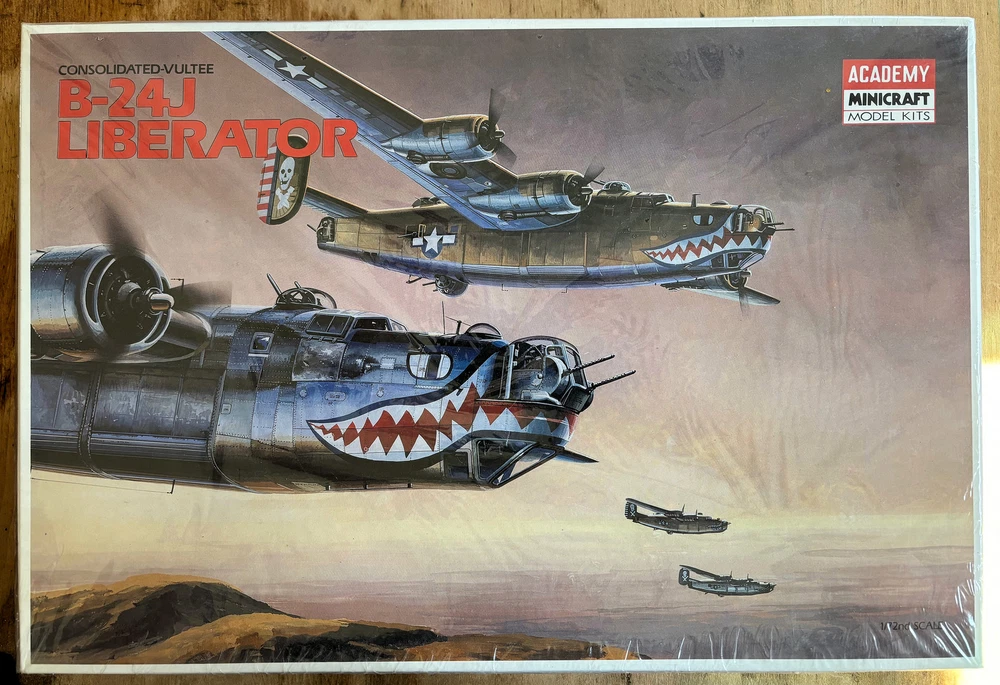
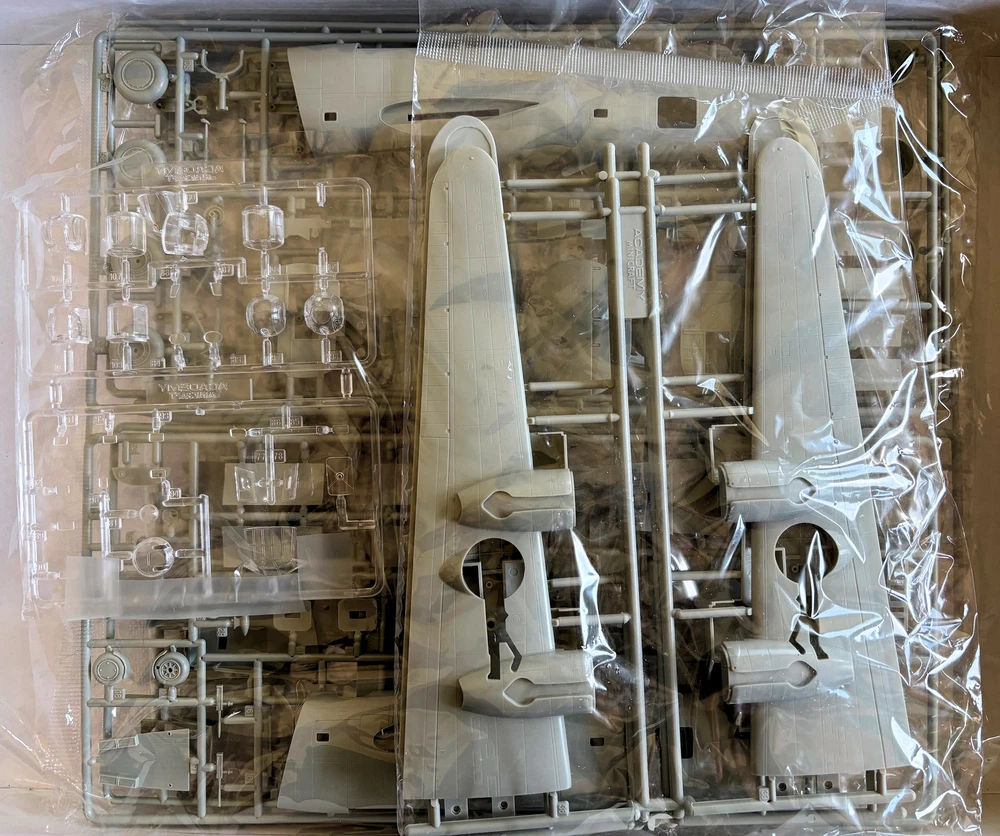
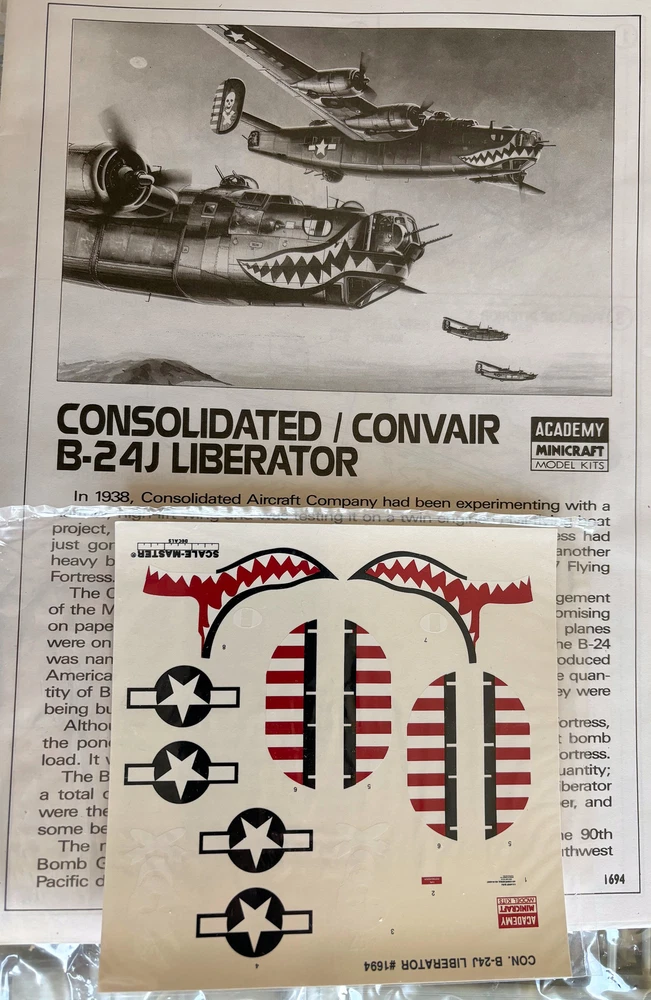
ACADEMY MINICRAFT 1/72-scale CONSOLIDATED B-24J LIBERATOR WW2 BG USAAF KIT #1694
$ 18.41
Description
ACADEMY MINICRAFT 1/72-scale CONSOLIDATED B-24J LIBERATOR WW2 BG USAAF KIT #1694 ACADEMY MINICRAFT 1/72-scale CONSOLIDATED B-24J LIBERATOR WW2 BG USAAF KIT #1694 -------------------------------------- Additional Information from Internet Encyclopedia The Consolidated B-24 Liberator is an American heavy bomber, designed by Consolidated Aircraft of San Diego, California. It was known within the company as the Model 32, and some initial production aircraft were laid down as export models designated as various LB-30s, in the Land Bomber design category. At its inception, the B-24 was a modern design featuring a highly efficient shoulder-mounted, high aspect ratio Davis wing. The wing gave the Liberator a high cruise speed, long range and the ability to carry a heavy bomb load. In comparison with its contemporaries, the B-24 was relatively difficult to fly and had poor low-speed performance; it also had a lower ceiling and was less robust than the Boeing B-17 Flying Fortress. While aircrews tended to prefer the B-17, General Staff favored the B-24 and procured it in huge numbers for a wide variety of roles. At approximately 18,500 units – including 8,685 manufactured by Ford Motor Company – it holds records as the world's most produced bomber, heavy bomber, multi-engine aircraft, and American military aircraft in history. The B-24 was used extensively in World War II where it served in every branch of the American armed forces, as well as several Allied air forces and navies. It saw use in every theater of operations. Along with the B-17, the B-24 was the mainstay of the US strategic bombing campaign in the Western European theater. Due to its range, it proved useful in bombing operations in the Pacific, including the bombing of Japan. Long-range anti-submarine Liberators played an instrumental role in closing the Mid-Atlantic gap in the Battle of the Atlantic. The C-87 transport derivative served as a longer range, higher capacity counterpart to the Douglas C-47 Skytrain. By the end of World War II, the technological breakthroughs of the Boeing B-29 Superfortress and other modern types had surpassed the bombers that served from the start of the war. The B-24 was rapidly phased out of U.S. service, although the PB4Y-2 Privateer maritime patrol derivative carried on in service with the U.S. Navy in the Korean War. The Liberator originated from a United States Army Air Corps (USAAC) request in 1938 for Consolidated to produce the B-17 under license. After company executives including President Reuben Fleet visited the Boeing factory in Seattle, Washington, Consolidated decided instead to submit a more modern design of its own. The new Model 32 combined designer David R. Davis's wing, a high-efficiency airfoil design created by unorthodox means, with the twin tail design from the Consolidated Model 31 flying boat, together on a new fuselage. This new fuselage was intentionally designed around twin bomb bays, each one being the same size and capacity of the B-17 bomb bays. In January 1939, the USAAC, under Specification C-212, formally invited Consolidated to submit a design study for a bomber with longer range, higher speed and greater ceiling than the B-17. The specification was written such that the Model 32 would automatically be the winning design. The program was run under the umbrella group, "Project A", an Air Corps requirement for an intercontinental bomber that had been conceived in the mid-1930s. Although the B-24 did not meet Project A goals, it was a step in that direction. Project A led to the development of the Boeing B-29 and Consolidated's own B-32 and B-36. Design The B-24 had a shoulder-mounted high aspect ratio Davis wing. This wing was highly efficient allowing a relatively high airspeed and long range. Compared to the B-17, it had a 6 feet (1.8 m) larger wingspan but a lower wing area. This gave the B-24 a 35-percent higher wing loading. The relatively thick wing held the promise of increased tankage while delivering increased lift and speed, but it became unpleasant to fly when committed to heavier loadings as experienced at high altitude and in bad weather. The Davis wing was also more susceptible to ice formation than contemporary designs, causing distortions of the aerofoil section and resulting in the loss of lift, with unpleasant experiences drawing such comments as, "The Davis wing won't hold enough ice to chill your drink".[9] The wing was also more susceptible to damage than the B-17's wing, making the aircraft less able to absorb battle damage. The wing carried four supercharged Pratt & Whitney R-1830-35 Twin Wasp engines mounted in cowlings borrowed from the PBY Catalina (similar except for being oval in cross-section allowing for oil coolers mounted on each side of the engine) that turned 3-bladed variable-pitch propellers. The tailplane featured two large oval vertical stabilizers mounted at the ends of a rectangular horizontal stabilizer. As early as 1942, it was recognized that the Liberator's handling and stability could be improved by the use of a single vertical fin. The single fin was tested by Ford on a single B-24ST variant and an experimental XB-24K: it was found to improve handling. However, all Liberators were produced with twin oval fins, with the exception of eight preproduction B-24N aircraft. The B-24N was intended as a major production variant featuring a single tail. Over 5000 orders for this version were placed in 1945, but they were cancelled due to the end of the war. The single fin did appear in production on the PB4Y Privateer derivative. The B-24's spacious, slab-sided fuselage (which earned the aircraft the nickname "Flying Boxcar") was built around two central bomb bays that could accommodate up to 8,000 pounds (3,600 kg) of ordnance in each compartment (but rarely did, as this decreased range and altitude). The forward and aft bomb bay compartments were further split longitudinally with a centerline ventral catwalk just nine inches (23 cm) wide, which also functioned as the fuselage's structural keel beam. An unusual four-panel set of all-metal, tambour-panel "roller-type" bomb bay doors, which operated very much like the movable enclosure of a rolltop desk, retracted into the fuselage. These types of doors created a minimum of aerodynamic drag to keep speed high over the target area; they also allowed the bomb bays to be opened while on the ground since the low ground clearance prevented the use of normal bomb bay doors. The occasional need during a mission for crewmen to move from fore to aft within the B-24's fuselage over the narrow catwalk was a drawback shared with other bomber designs. The Liberator carried a crew of up to ten. The pilot and co-pilot sat alongside each other in a well-glazed cockpit. The navigator and bombardier — who could also double as a nose or wiggly ear gunners (guns mounted in the sides of the aircraft nose) — sat in the nose, fronted on the pre-B-24H models with a well-framed "greenhouse" nose with some two dozen glazed panels and with two flexible ball-mounts built into it for forward defensive firepower using .30 caliber (7.62 mm) Browning M1919 machine guns (later versions were fitted with a powered twin-.50 caliber (12.7 mm) M2 Browning machine gun nose turret). The radio/radar operator sat behind the pilots, facing sideways and sometimes doubled as a waist gunner. The flight engineer sat adjacent to the radio operator behind the pilots; he operated the upper gun turret (when fitted), located just behind the cockpit and in front of the wing. Up to four crew members could be located in the waist, operating waist guns, a retractable lower ball turret gun, and a tail gun turret matching the nose turret. The waist gun hatches were provided with doors. The ball turret was required to be retractable for ground clearance when preparing to land as well as for greater aerodynamic efficiency. The tail gunner's powered twin-gun turret was located at the end of the tail, behind the tailplane. The B-24 featured a tricycle undercarriage, the first American bomber to do so, with the main gear extending out of the wing on long, single-oleo strut legs. It used differential braking and differential thrust for ground steering, which made taxiing difficult. Armament The defensive armament of the B-24 varied from transport variants, which were usually unarmed, to bombers armed with up to ten .50 caliber (12.7 mm) M2 Browning machine guns located in turrets and waist gun positions. Early model Liberators were fitted with a top-mounted turret, a tail turret and single machine guns located in the waist and in the glazed nose. The B-24D initially featured upper, belly and tail turrets, plus swiveling single guns in the waist and on either side of the nose. The belly turret was a periscopically sighted Bendix model. The turret proved unsatisfactory and was soon replaced by a tunnel gun, which was itself omitted. Later D models were fitted with the retractable Sperry ball turret. The B-24H saw the replacement of the glazed 'green house' nose with a nose turret, which reduced the B-24s vulnerability to head-on attacks. The bombsight was located below the turret. Long-range naval patrol versions often carried a light defensive armament. Being on long-distance patrols, they generally flew outside the range of enemy fighters. Also, the necessity of range increased the importance of weight and aerodynamic efficiency. Thus naval patrol often omitted top, belly and nose turrets. Some were fitted with a belly pack containing fixed, forward-facing cannon. For much of 1944, the B-24 was the predominant bomber of U.S. Strategic Air Forces (USSTAF) formerly the Eighth Air Force in the Combined Bomber Offensive against Germany, forming nearly half of its heavy bomber strength in the ETO prior to August and most of the Italian-based force. Thousands of B-24s flying from bases in Europe dropped hundreds of thousands of tons of high explosive and incendiary bombs on German military, industrial, and civilian targets. The 44th Bombardment Group was one of the first two heavy bombardment groups flying the B-24 with the 8th Air Force in the fall/winter air campaigns in the European Theater of Operations. The 44th Bomb Group flew the first of its 344 combat missions against the Axis powers in World War II on 7 November 1942. The first B-24 loss over German territory occurred on 26 February 1943. Earlier in the war, both the Luftwaffe and the Royal Air Force had abandoned daylight bombing raids because neither could sustain the losses suffered. The Americans persisted, however, at great cost in men and aircraft. In the period between 7 November 1942 and 8 March 1943, the 44th Bomb Group lost 13 of its original 27 B-24s. For some time, newspapers had been requesting permission for a reporter to go on one of the missions. Robert B. Post and five other reporters of The New York Times were granted permission. Post was the only reporter assigned to a B-24-equipped group, the 44th Bomb Group. He flew in B-24 41-23777 ("Maisey") on Mission No. 37 to Bremen, Germany. Intercepted just short of the target, the B-24 came under attack from JG 1's Messerschmitt Bf 109s. Leutnant Heinz Knoke (who finished the war with 31 kills) shot down the Liberator. Post and all but two of the 11 men aboard were killed. Knoke reported: "The fire spread out along the right wing. The inboard propeller windmilled to a stop. And then, suddenly, the whole wing broke off. At an altitude of 900 metres there was a tremendous explosion. The bomber had disintegrated. The blazing wreckage landed just outside Bad Zwischenahn airfield." A total of 177 B-24s carried out the famous second attack on Ploiești (Operation Tidal Wave) on 1 August 1943. This was the B-24's most costly mission. In late June 1943, the three B-24 Liberator groups of the 8th Air Force were sent to North Africa on temporary duty with the 9th Air Force: the 44th Bomb Group joined the 93rd and the 389th Bomb Groups. These three units then joined the two 9th Air Force B-24 Liberator groups for low-level attack on the Romanian oil complex at Ploiești. This daring assault by high-altitude bombers at treetop level was a costly success. The attack became disorganized after a navigational error which alerted the defenders and protracted the bomb run from the initial point. The 44th destroyed both of its assigned targets, but lost 11 of its 37 bombers and their crews. Colonel Leon W. Johnson, the 44th's commander, was awarded the Medal of Honor for his leadership, as was Col. John Riley "Killer" Kane, commander of the 98th Bomb Group. Kane and Johnson survived the mission but three other recipients of the Medal of Honor for their actions in the mission—Lt. Lloyd H. Hughes, Maj. John L. Jerstad and Col. Addison E. Baker—were killed in action. For its actions on the Ploiești mission, the 44th was awarded its second Distinguished Unit Citation. Of the 177 B-24s that were dispatched on this operation, 54 were lost. The B-24 advanced the use of electronic warfare and equipped Search Bomber (SB), Low Altitude (LAB) and Radar Counter Measure (RCM) squadrons in addition to high-altitude bombing. Among the specialized squadrons were the 20th RS (RCM), 36th BS (RCM), 406th NLS, 63rd BS (SB) SeaHawks, 373rdBS (LAB) and 868th BS (SB) Snoopers. The 36th Bombardment Squadron was the Eighth Air Force's only electronic warfare squadron using specially equipped B-24s to jam German VHF communications during large Eighth Air Force daylight raids. In addition, the 36th BS flew night missions with RAF Bomber Command's own electronic warfare unit 100 Group at RAF Sculthorpe. Radar Counter Measures (RCM) was code-named Carpet, however, this should not be confused with agent and supply drops, code-named "Carpetbaggers". The B-24 was the platform for the pioneering use of the Americans' Azon laterally-guidable precision-guided munition ordnance design, a pioneering Allied radio-guided munition system during World War II. The ordnance of 1,000 lb weight, was deployed operationally by USAAF B-24s in both Europe and the CBI theaters. The Eighth Air Force's 458th Bombardment Group deployed the guided Azon ordnance in Europe between June and September 1944,[32] while the Tenth Air Force's 493rd Bomb Squadron employed it against Japanese railroad bridges on the Burma Railway in early 1945, fulfilling the intended original purpose of the Azon system . The B-24J was similar to the B-24H, but shortages of the Emerson nose turret required use of a modified, hydraulically powered Consolidated A-6 turret in most J model aircraft built at Consolidated's San Diego and Fort Worth factories. The B-24J featured an improved autopilot (type C-1) and a M-1 series bombsight. B-24H sub-assemblies made by Ford and constructed by other companies and any model with a C-1 or M-1 retrofit, were all designated B-24J. The J model was the only version to be built by all five factories involved in B-24 production. (Total: 6,678) FREE scheduling, supersized images and templates. Get Vendio Sales Manager. Make your listings stand out with FREE Vendio custom templates! FREE scheduling, supersized images and templates. Get Vendio Sales Manager. Over 100,000,000 served. Get FREE counters from Vendio today!